
Science Fiction
Dictionary
A B C D E F G H I J K L M N O P Q R S T U V W X Y Z
Latest By
Category:
Armor
Artificial
Intelligence
Biology
Clothing
Communication
Computers
Culture
Data Storage
Displays
Engineering
Entertainment
Food
Input Devices
Lifestyle
Living Space
Manufacturing
Material
Media
Medical
Miscellaneous
Robotics
Security
Space Tech
Spacecraft
Surveillance
Transportation
Travel
Vehicle
Virtual
Person
Warfare
Weapon
Work
"I identify with the weak person; this is one reason why my fictional protagonists are essentially antiheroes."
- Philip K. Dick

 |
| Sympathetic Block | ||
| A way to keep certain mental contents from being spoken or revealed. |

This technovelgy takes advantage of the connections between the cerebral cortex and the autonomic nervous system. If you are consciously aware that the intention to reveal protected information arises in your mind, your central nervous system shuts down essential body functions. This might go through what we now call the emotional brain.
| "They've been given Sympathetic Blocks. You know about SBs, girl? Intelligence uses them for espionage agents. Take a certain body of information you don't want told. Link it with the sympathetic nervous system that controls autonomic respiration and heart beat. As soon as the subject tries to reveal that information, the block comes down, the heart and lungs stop, the man dies, your secret's kept. An agent doesn't have to worry about killing himself to avoid torture; it's been done for him." |
| Technovelgy from The Stars My Destination,
by Alfred Bester. Published by Berkley in 1956 Additional resources -
|
Gully Foyle finds a way to get around the sympathetic block by accelerating himself to 5x speed and then bypassing the heart entirely to support the SB patient with a heart pump:
He cut through skin and fascia, sawed through the rib cage, exposed the heart, snipped it out and connected veins and arteries to the intricate blood-pump alongside the table. He started the pump. Twenty seconds, objective time, had elapsed. He placed an oxygen mask over Kempsey's face and switched on the alternating suction and eructation of the oxygen pump.
Foyle decelerated, checked Kempsey's temperature, shot an anti-shock series into his veins and waited. Blood gurgled through the pump and Kempsey's body. After five minutes, Foyle removed the oxygen mask. The respiration reflex continued. Kempsey was without a heart, yet alive. Foyle sat down alongside the operating table and waited. The stigmata still showed on his face.
Kempsey awoke, screaming.
Foyle leaped up, tightened the straps and leaned over the heartless man.
"Look at yourself, Kempsey. You're dead."
Kempsey fainted. Foyle brought him to with the oxygen mask.
"Let me die, for God's sake!"
"I died for six months and I didn't whine."
"Let me die!"
"In time, Kempsey. Your sympathetic block's been by-passed, but I'll let you die in time, if you behave.
First successful use of such a device in a human being was on May 6, 1953 by Dr. John H. Gibbon Jr. at Thomas Jefferson University Hospital, Philadelphia. 18-year-old Cecelia Bavolek had a large atrial septal defect. The machine maintained full cardiopulmonary bypass for 26 minutes during the repair (total time on bypass 45–75 minutes in some accounts).
The surgery was completely successful. The patient made a full recovery and lived for many years afterward. This is universally recognized as the first successful open-heart operation using a heart-lung machine to fully replace the heart's pumping and lung's oxygenation functions in a living human.
A similar concept is seen in Methuselah's Children, by Robert Heinlein, which was written in 1958 (see hypnotic injunction).
Foyle strapped the body on the operating table, opened a case of surgical instruments, and began the delicate operation he had learned by hypno-training that morning— an operation made possible only by his five-to-one acceleration.
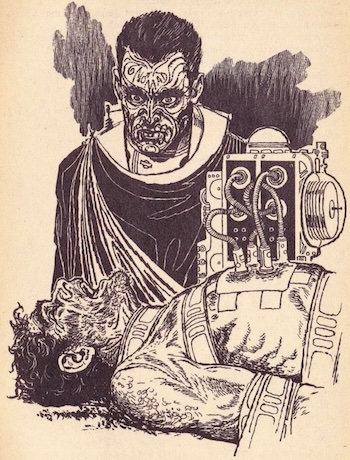
(Sympathetic Block Surgery 5x Speed in 'The Stars My Destination' by Alfred Bester)
Comment/Join this discussion ( 0 ) | RSS/XML | Blog This |
Additional
resources:
More Ideas
and Technology from The Stars My Destination
More Ideas
and Technology by Alfred Bester
Tech news articles related to The Stars My Destination
Tech news articles related to works by Alfred Bester
| 3D Printed Organs From Space |
| Health Kiosk Has No Human Doctor |
| NEO Brain Computer Interface (BCI) |
| MIT Computerized Bionic Leg Is Part Of The User |
Want to Contribute an
Item?
It's easy:
Get the name of the item, a
quote, the book's name and the author's name, and Add
it here.
| <Previous | Next> |
|
|
|
Technovelgy (that's tech-novel-gee!) is devoted to the creative science inventions and ideas of sf authors. Look for the Invention Category that interests you, the Glossary, the Science Fiction Invention Timeline, or see what's New.
|

Science Fiction
Timeline
1600-1899
1900-1939
1940's 1950's
1960's 1970's
1980's 1990's
2000's 2010's
'Our study of your race has convinced us that you are not fitted to leave your planet in the present state of your civilization.'
'...the spreading beam of the deranging ray struck them, and Then one toppled and fell. Then another.'
'Within seconds the material was spread out over fifty yards, in a matter of hours it might occupy several cubic miles of space...'
'The men are dead, but their acquired wisdom lives on and I am the beneficiary.'
'Young people found the driverless car admirable for petting.'
'After twenty generations of shillyshallying...'

