
Science Fiction
Dictionary
A B C D E F G H I J K L M N O P Q R S T U V W X Y Z

 |
Self-Replicating Modular Robots

Hod Lipson, Victor Zykov, Efstathios Mytilinaios and Bryant Adams have been working on machines that replicate themselves. Their strategy is to use small modules that attach to each other with electromagnets.
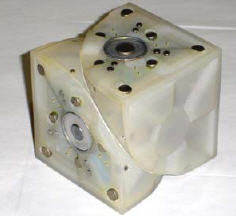
(From Self-Replicating Machine Module)
Each ten centimeter cube is an autonomous unit with a microprocessor and a set of instructions on how to link themselves with other modules.
For example, four blocks piled up on top of each other to form a tower can create another identical tower by swiveling around and picking up other blocks and piling them up. Obviously, much larger and more complex structures can be built by expanding on this model.
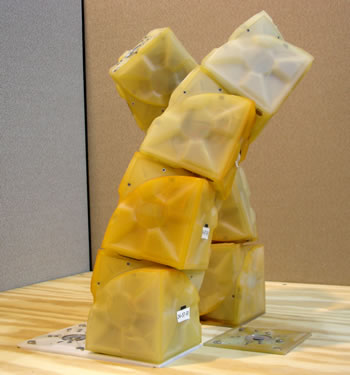
(From Self-Replicating Machine Pictures)
The self-reproducing machines demonstrate here are essentially modular robots, composed of multiple identical actuated modules with electromagnets to selectively weaken and strengthen connections so as to determine where the structure breaks and joins. Each module is a 10cm cube, split into two halves... One half of the cube can swivel relative to another half in increments of 120°, each time cycling three faces of the cube. Connected cubes can thus form and reconfigure into arbitrary morphologies... The cubes are powered at the base and transfer data and power through their faces. The control of the machine is distributed among the modules: A microcontroller onboard each module executes a motion schedule governed by time and contact events.
(From Self-reproducing Machines pdf)
John von Neumann was the first scientist to do rigorous work on the topic of self-replicating machines. However, science fiction author Philip K. Dick beat him to the punch with his 1955 short story Autofac, which described an automated factory that also had the capacity to reproduce itself by shooting tiny pellets full of nanomachines into the distance:
"They're building," O'Neill said, awed. He got up and prowled on. Off to the side, at the far edge of the gully, he came across a downed pellet far advanced on its construction...This one had made great enough progress to be identified. Minute as it was, the structure was familiar. The machinery was building a miniature replica of the demolished factory.
(Read more about Philip K. Dick's autofac)
I'd also add a reference to a more structured version of this idea, the Robot Cells (Crystal-Shaped Modules) from 1987 work by Michael P. Kube-McDowell.
The concepts explored by these simple modules may also have applications on other planets:
Self-replication could have major implications for how robots are used in remote environments where repairing them is difficult. "Self-replication is the ultimate form of repair," Lipson says. "You can imagine robotic systems on Mars or at the ocean bottom repairing themselves using a mechanism like this."
Read more about how autonomous modular machines might be used on other planets in TETWalker: Shape-Shifting Robot Swarm. See the Cornell Self-Replication website and the article at New Scientist . Thanks to Trevor Curran for the tip on this story.
Scroll down for more stories in the same category. (Story submitted 5/11/2005)
Follow this kind of news @Technovelgy.| Email | RSS | Blog It | Stumble | del.icio.us | Digg | Reddit |
Would
you like to contribute a story tip?
It's easy:
Get the URL of the story, and the related sf author, and add
it here.
Comment/Join discussion ( 3 )
Related News Stories - (" Robotics ")
Epirus High-Power Microwave Defeats Drones
'...the spreading beam of the deranging ray struck them, and Then one toppled and fell. Then another.' - Ray Cummings, 1931.
It's A Giant Robot! You Reporters Have Been Warned!
'... completely forgetting the ship at sight of the awesome figure and great head of the giant Gaut...'
Tactile Skin Supplier Map
'What strange sensitivity! What an amazing development of science was manifested in every move and act and word of this Robot!' - Ray Cummings, 1931.
Robot Bees 3D Printed By Festo
'At first I was struck by the large size of these bees..' - Ernst Junger, 1957.
Technovelgy (that's tech-novel-gee!) is devoted to the creative science inventions and ideas of sf authors. Look for the Invention Category that interests you, the Glossary, the Invention Timeline, or see what's New.

Science Fiction
Timeline
1600-1899
1900-1939
1940's 1950's
1960's 1970's
1980's 1990's
2000's 2010's
Current News
'If Anyone Is Watching Earth...'
'Our study of your race has convinced us that you are not fitted to leave your planet in the present state of your civilization.'
Epirus High-Power Microwave Defeats Drones
'...the spreading beam of the deranging ray struck them, and Then one toppled and fell. Then another.'
Cloud Of Space Rubbish From China's Long March Rocket
'Within seconds the material was spread out over fifty yards, in a matter of hours it might occupy several cubic miles of space...'
Biomimetic Tendons From Rochu Robotics
'... the curious parallelism to animal motions.'
Living Human Neuron Biological Compute Rack
'The men are dead, but their acquired wisdom lives on and I am the beneficiary.'
Martha Stewart Approves Ojai 'Living Room On Wheels'
'Young people found the driverless car admirable for petting.'
ESA's Draco To Study Heat Of Reentry
'...a synthetic which air-friction would erode.'
Buy A Galaxy? Maybe Start Smaller
'The sky is the limit' just got higher.
The United States Space Academy Is Official
'Is our orbit to Space Academy clear?'
Is There A Global Problem With Who Is Having Children?
'After twenty generations of shillyshallying...'
You Will Eat The Cookies Made From Plastic...
'Our planes are going to start bringing in bales of discarded plastics...'
It's A Giant Robot! You Reporters Have Been Warned!
'... completely forgetting the ship at sight of the awesome figure and great head of the giant Gaut...'
Birds Learn To Sing Pictures ala Frank Herbert's Distrans
'We will fight in the time of fighting.'
ElectionSim: China's 'Ender's Game' Battle Sim, Or Lem's 'Kingdom In A Box'?
'So, Ender, we will now begin your education.'
Tactile Skin Supplier Map
'What strange sensitivity! What an amazing development of science was manifested in every move and act and word of this Robot!'
Flock Stymied By 'Adversarial Fashion'
'Forget the head atop it, the legs below, feet, arms, hands. It compels erasure.'

