
Science Fiction
Dictionary
A B C D E F G H I J K L M N O P Q R S T U V W X Y Z

 |
Space Solar Power - A Truly Limitless Source

The National Space Society presented an international assessment of space solar power. The report is presented in the context of increasing global power needs: 220 trillion kiloWatt hours per year by 2030, which is double today's power output. It will double again by 2090.
The Academy study found that the SPS concept has significant potential to meeting global
requirements for largely carbon-neutral energy during the coming century. The study found the SPS concept to be technically viable, and that it may well be possible to achieve economic viability.
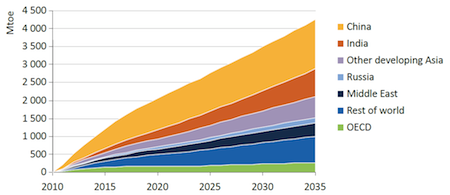
(Global energy demand 2010-2035 [pdf])
The concept of the “solar power satellite” (SPS) was invented first by Dr. Peter Glaser in the late 1960s. Figure 1-2 depicts the conceptual illustration of an SPS presented in Dr. Glaser’s original patent on the concept, granted on 25 December 1973.The SPS concept can be regarded as quite elegant: a large platform, positioned in space in a high Earth orbit continuously collects and converts solar energy into electricity. This power is then used to drive a wireless power transmission (WPT) system that transmits the solar energy to receivers on Earth. Because of its immunity to nighttime, to weather or to the changing seasons, the SPS concept has the potential to achieve much greater energy-efficiency than ground based solar power systems.
Since its invention, there have been numerous studies and technology projects conducted by various government agencies, companies and universities that have been focused on the goal of the Solar Power Satellite.
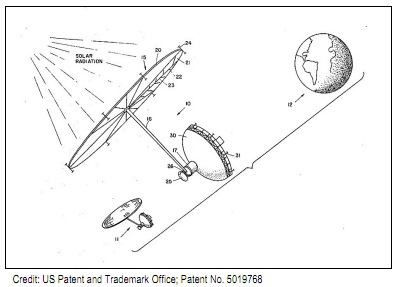
(Illustration of the SPS Concept from the 1973 Patent [pdf])
The 250 page study's findings can be summarized as follows:
- Fundamentally new energy technologies clearly appear to be needed during the coming decades under all examined scenarios – both to support continued (and sustainable) global economic growth, and for reasons of environmental/climate concerns. Solar energy from space appears to be a promising candidate that can contribute to address these challenges.
- Solar Power Satellites appear to be technically feasible as soon as the coming 10-20 years using technologies existing now in the laboratory that could be developed / demonstrated (depending on the systems concept details).
- Economically viable Solar Power Satellites appear achievable during the next 1-3 decades, but more information is needed concerning both the details of potential system costs and the details of markets to be served.
- An in-depth end-to-end systems analysis of SSP/SPS is necessary to understand more fully the interactions among various systems / technologies for different concepts and markets; however, no such study has been performed since the conclusion of NASA’s Fresh Look Study in 1997.
- Low-cost Earth-to-orbit transportation is an enabling capability to the economic viability of space solar power for commercial baseload power markets.
- Systems studies are not enough. Technology Flight Experiments (TFEs) to test critical technology elements and Technology Flight Demonstrations (TFD) that validate SPS systems concepts to a high level of maturity appear to be essential in order to build confidence.
- The SPS concept is sufficiently transformational and entails enough technical uncertainties such that major systems level in-space demonstrations will be necessary to establish technical feasibility, engineering characteristics and economical viability before any organization is likely to proceed with full-scale development.
Although Dr. Peter Glaser is credited with inventing the basic concept, it is nevertheless true that science fiction authors had been popularizing the idea for at least a generation.
In his 1931 story Power Planet, Murray Leinster detailed the idea of a power planet, a very large satellite used to gather solar energy and beam it back to Earth:
The Power Planet, of course, is that vast man-made disk of metal set spinning about the sun to supply the Earth with power. Everybody learns in his grammar-school textbooks of its construction just beyond the Moon and of its maneuvering to its present orbit by a vast expenditure of rocket fuel.Only forty million miles from the sun's surface, its sunward side is raised nearly to red heat by the blazing radiation. And the shadow side, naturally, is down to the utter cold of space. There is a temperature drop of nearly seven hundred degrees between the two sides, and Williamson cells turn that heat-difference into electric current, with an efficiency of 99 percent. Then the big Dugald tubes - they are twenty feet long on the Power Planet - transform it into the beam which is focused on the Earth and delivers something over a billion horsepower to the various receivers that have been erected.
(Read more about Leinster's Power Planet)
Fans of Golden Age sf also recall with fondness the Near-Space Solar Energy Collectors from Olaf Stapledon's 1937 novel Star Maker and the Solar Energy Beam from Clifford Simak's 1941 story Masquerade.
From Space Solar Power - THE FIRST INTERNATIONAL ASSESSMENT OF SPACE SOLAR POWER: OPPORTUNITIES, ISSUES AND POTENTIAL PATHWAYS FORWARD via Kurzweil AI.
Scroll down for more stories in the same category. (Story submitted 11/28/2011)
Follow this kind of news @Technovelgy.| Email | RSS | Blog It | Stumble | del.icio.us | Digg | Reddit |
Would
you like to contribute a story tip?
It's easy:
Get the URL of the story, and the related sf author, and add
it here.
Comment/Join discussion ( 0 )
Related News Stories - (" Space Tech ")
'If Anyone Is Watching Earth...'
'Our study of your race has convinced us that you are not fitted to leave your planet in the present state of your civilization.' - Arthur C. Clarke, 1946.
Cloud Of Space Rubbish From China's Long March Rocket
'Within seconds the material was spread out over fifty yards, in a matter of hours it might occupy several cubic miles of space...'
ESA's Draco To Study Heat Of Reentry
'...a synthetic which air-friction would erode.' - EE Doc Smith, 1934.
The United States Space Academy Is Official
'Is our orbit to Space Academy clear?' - Carey Rockwell
Technovelgy (that's tech-novel-gee!) is devoted to the creative science inventions and ideas of sf authors. Look for the Invention Category that interests you, the Glossary, the Invention Timeline, or see what's New.

Science Fiction
Timeline
1600-1899
1900-1939
1940's 1950's
1960's 1970's
1980's 1990's
2000's 2010's
Current News
'If Anyone Is Watching Earth...'
'Our study of your race has convinced us that you are not fitted to leave your planet in the present state of your civilization.'
Epirus High-Power Microwave Defeats Drones
'...the spreading beam of the deranging ray struck them, and Then one toppled and fell. Then another.'
Cloud Of Space Rubbish From China's Long March Rocket
'Within seconds the material was spread out over fifty yards, in a matter of hours it might occupy several cubic miles of space...'
Biomimetic Tendons From Rochu Robotics
'... the curious parallelism to animal motions.'
Living Human Neuron Biological Compute Rack
'The men are dead, but their acquired wisdom lives on and I am the beneficiary.'
Martha Stewart Approves Ojai 'Living Room On Wheels'
'Young people found the driverless car admirable for petting.'
ESA's Draco To Study Heat Of Reentry
'...a synthetic which air-friction would erode.'
Buy A Galaxy? Maybe Start Smaller
'The sky is the limit' just got higher.
The United States Space Academy Is Official
'Is our orbit to Space Academy clear?'
Is There A Global Problem With Who Is Having Children?
'After twenty generations of shillyshallying...'
You Will Eat The Cookies Made From Plastic...
'Our planes are going to start bringing in bales of discarded plastics...'
It's A Giant Robot! You Reporters Have Been Warned!
'... completely forgetting the ship at sight of the awesome figure and great head of the giant Gaut...'
Birds Learn To Sing Pictures ala Frank Herbert's Distrans
'We will fight in the time of fighting.'
ElectionSim: China's 'Ender's Game' Battle Sim, Or Lem's 'Kingdom In A Box'?
'So, Ender, we will now begin your education.'
Tactile Skin Supplier Map
'What strange sensitivity! What an amazing development of science was manifested in every move and act and word of this Robot!'
Flock Stymied By 'Adversarial Fashion'
'Forget the head atop it, the legs below, feet, arms, hands. It compels erasure.'

