
Science Fiction
Dictionary
A B C D E F G H I J K L M N O P Q R S T U V W X Y Z

 |
Mars Mission Using Nuclear Thermal Propulsion

Should we develop space nuclear propulsion technology to reach destinations in the solar system more quickly than low-energy Hohmann transfer orbits?
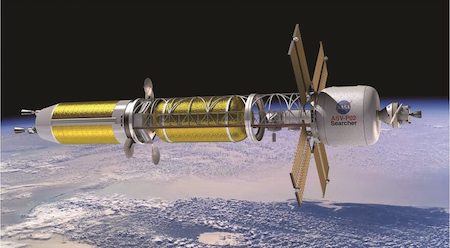
(Mars mission concept enabled by nuclear thermal propulsion)
It is naive and against national interests for the U.S. to rely on expensive, outdated, slow, single-use chemically propelled rockets like SLS to transport astronauts to Mars. Instead, America must aggressively invest in developing space nuclear propulsion systems.Nuclear technology, including nuclear electric propulsion (or “NEP”) and nuclear thermal propulsion (or “NTP”), will be a space travel game-changer with profound implications for deep space mission speed, agility and capability.
The increased propulsive power of nuclear systems will allow humans to head to Mars on a more regular cadence than the current mission launch windows of “every 26 months.” Nuclear propulsion also will allow power for astronauts on Mars missions to abort and return to Earth in the event of an emergency.
Obviously, science fiction writers are down with this program. I guess I think most strongly of that moment in Heinlein's 1961 novel Stranger in a Strange Land when he describes the crossing to Mars taking place in just nineteen days under Lyle Drive:
The Federation Ship Champion, manned by an all-male crew of eighteen experienced spacemen and carrying more than that number of male pioneers, made the crossing under Lyle Drive in only nineteen days. The Champion landed just south of Lacus Soli, as Captain van Tromp intended to search for the Envoy.
Even earlier, Eando Binder describes a similar journey to Mars in his 1932 short story The First Martian:
(The First Martian by Eando Binder)The inconceivable distance to be traversed, the enormous energy required to transport a heavy machine from planet to planet, and the all-powerful force of gravity, seemed insurmountable objects to even the most broadminded and optimistic thinkers. Feeble attempts were made even in 1931 to leave this speck of the universe and soar to other worlds, but constant failures dulled the ardor of those who wished to connect our world with the others which acknowledge the same central sun...
Although the fatalities far exceeded these probable successes, the hope of interplanetary travel was still uppermost in our minds. We know now, that our failure can be attributed to the unfortunate lack of radioactive elements, and not to the lack of ingenuity or inventiveness.
It was only too true. as Professor Billings stated in 1945, that the only type of engine which could possibly transport a heavy machine from our earth to some planet, would have to be the atomic-energy engine, which, with a minimum of fuel and the very necessary radioactive element, could develop an unlimited amount of energy.
He even drew plans of the basic principles of such an engine, estimated the amount of radioactive material needed, and worked out the propulsion of the ship.
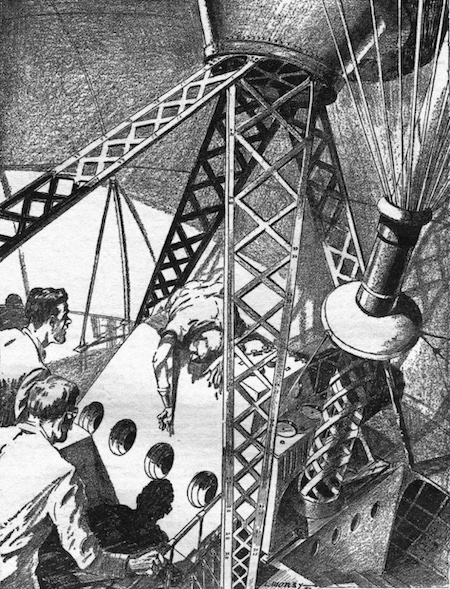
As far as I know, the first reference to an "atomic engine" can be found in HG Wells' 1914 short story The World Set Free - but not in a space craft:
...the swift aëroplane, with its atomic engine as noiseless as a dancing sunbeam... flew like an arrow to the heart of the central European hosts.
Scroll down for more stories in the same category. (Story submitted 12/27/2022)
Follow this kind of news @Technovelgy.| Email | RSS | Blog It | Stumble | del.icio.us | Digg | Reddit |
Would
you like to contribute a story tip?
It's easy:
Get the URL of the story, and the related sf author, and add
it here.
Comment/Join discussion ( 0 )
Related News Stories - (" Space Tech ")
'If Anyone Is Watching Earth...'
'Our study of your race has convinced us that you are not fitted to leave your planet in the present state of your civilization.' - Arthur C. Clarke, 1946.
Cloud Of Space Rubbish From China's Long March Rocket
'Within seconds the material was spread out over fifty yards, in a matter of hours it might occupy several cubic miles of space...'
ESA's Draco To Study Heat Of Reentry
'...a synthetic which air-friction would erode.' - EE Doc Smith, 1934.
The United States Space Academy Is Official
'Is our orbit to Space Academy clear?' - Carey Rockwell
Technovelgy (that's tech-novel-gee!) is devoted to the creative science inventions and ideas of sf authors. Look for the Invention Category that interests you, the Glossary, the Invention Timeline, or see what's New.

Science Fiction
Timeline
1600-1899
1900-1939
1940's 1950's
1960's 1970's
1980's 1990's
2000's 2010's
Current News
'If Anyone Is Watching Earth...'
'Our study of your race has convinced us that you are not fitted to leave your planet in the present state of your civilization.'
Epirus High-Power Microwave Defeats Drones
'...the spreading beam of the deranging ray struck them, and Then one toppled and fell. Then another.'
Cloud Of Space Rubbish From China's Long March Rocket
'Within seconds the material was spread out over fifty yards, in a matter of hours it might occupy several cubic miles of space...'
Biomimetic Tendons From Rochu Robotics
'... the curious parallelism to animal motions.'
Living Human Neuron Biological Compute Rack
'The men are dead, but their acquired wisdom lives on and I am the beneficiary.'
Martha Stewart Approves Ojai 'Living Room On Wheels'
'Young people found the driverless car admirable for petting.'
ESA's Draco To Study Heat Of Reentry
'...a synthetic which air-friction would erode.'
Buy A Galaxy? Maybe Start Smaller
'The sky is the limit' just got higher.
The United States Space Academy Is Official
'Is our orbit to Space Academy clear?'
Is There A Global Problem With Who Is Having Children?
'After twenty generations of shillyshallying...'
You Will Eat The Cookies Made From Plastic...
'Our planes are going to start bringing in bales of discarded plastics...'
It's A Giant Robot! You Reporters Have Been Warned!
'... completely forgetting the ship at sight of the awesome figure and great head of the giant Gaut...'
Birds Learn To Sing Pictures ala Frank Herbert's Distrans
'We will fight in the time of fighting.'
ElectionSim: China's 'Ender's Game' Battle Sim, Or Lem's 'Kingdom In A Box'?
'So, Ender, we will now begin your education.'
Tactile Skin Supplier Map
'What strange sensitivity! What an amazing development of science was manifested in every move and act and word of this Robot!'
Flock Stymied By 'Adversarial Fashion'
'Forget the head atop it, the legs below, feet, arms, hands. It compels erasure.'

