
Science Fiction
Dictionary
A B C D E F G H I J K L M N O P Q R S T U V W X Y Z

 |
Shape-Changing Metal Antenna

Researchers at Utah and North Carolina have created a controllable metal antenna that can change its shape, and thus the frequency at which it resonates, on demand.
(Shape-Changing Metal Antenna)
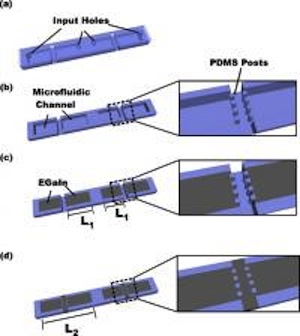
To fabricate the antenna, the researchers injected a conductive, low-viscosity metal alloy (eutectic gallium indium, or EGaIn) into a 51-mm-long microchannel that is divided into four segments. Two rows of posts placed perpendicular to the channel divide the inner and outer segments of the antenna. A thin, membrane-like solid oxide skin spontaneously forms on the metal surface that mechanically stabilizes the metal at the posts, preventing metal in adjacent segments from merging. The liquid metal remains stable as long as its surface oxide is not ruptured.At a length of 25 mm, the initial dipole antenna state, defined by the two inner segments, represents the shortest of three possible states. As the shortest antenna, it also has the highest frequency. In order to elongate the antenna, and thus decrease its frequency, the researchers applied a critical pressure on the liquid metal at one segment boundary. This critical pressure ruptures the oxide skin and squirts the metal between the posts to merge with one of the outermost metal segments. This process increases the length of the antenna and creates a second state at a lower frequency than the first state. By controlling the spacing between the posts, the researchers could control the pressure at which the oxide ruptures.
To achieve the third state – the one with the longest length and lowest frequency – the researchers ruptured the skin on the other side of the antenna, allowing the liquid metal in the inner segment to merge with the other outer segment. Once the skin is ruptured, the metal flows extremely quickly – in a few milliseconds – due to its low viscosity and the short distance it has to travel.
In his 1942 novella Waldo, Heinlein draws on the idea of broadcast power. The aircars (including the amazing broomstick speedster) use standard, rigid antennas to draw power.
As the story progresses, the deKalb antennas mysteriously fail to function. When one of them is fixed by a "hex doctor", engineers go to investigate.
"What!" put in Stevens. "You don't mean to stand there and tell me an old witch doctor fixed your deKalbs.""Not witch doctor - hex doctor..."
The skycar looked quite ordinary. Stevens examined the deKalbs and saw some faint chalk marks on their metal sides... "Watch while I cut in reception."
Stevens waited, heard the faint hum as the circuits became activized and looked.
The antennae of the deKalbs, each a rigid pencil or metal, were bending, flexing, writhing like a cluster of worms. They were reaching out, like fingers...
(Read more about Heinlein's broadcast power receptors)
From Physorg.
Scroll down for more stories in the same category. (Story submitted 7/31/2011)
Follow this kind of news @Technovelgy.| Email | RSS | Blog It | Stumble | del.icio.us | Digg | Reddit |
Would
you like to contribute a story tip?
It's easy:
Get the URL of the story, and the related sf author, and add
it here.
Comment/Join discussion ( 0 )
Related News Stories - (" Engineering ")
Biomimetic Tendons From Rochu Robotics
'... the curious parallelism to animal motions.' - HG Wells, 1898.
You Will Eat The Cookies Made From Plastic...
'Our planes are going to start bringing in bales of discarded plastics...' - Rick Shelley, 1989.
ICE Buys Shock Gloves Like Batman's
What else is the Caped Crusader using?
When Colds Threaten You Can't Do This - Or Can You?
'...a hemispherical force field enclosing his head.' - FL Wallace, 1955.
Technovelgy (that's tech-novel-gee!) is devoted to the creative science inventions and ideas of sf authors. Look for the Invention Category that interests you, the Glossary, the Invention Timeline, or see what's New.

Science Fiction
Timeline
1600-1899
1900-1939
1940's 1950's
1960's 1970's
1980's 1990's
2000's 2010's
Current News
'If Anyone Is Watching Earth...'
'Our study of your race has convinced us that you are not fitted to leave your planet in the present state of your civilization.'
Epirus High-Power Microwave Defeats Drones
'...the spreading beam of the deranging ray struck them, and Then one toppled and fell. Then another.'
Cloud Of Space Rubbish From China's Long March Rocket
'Within seconds the material was spread out over fifty yards, in a matter of hours it might occupy several cubic miles of space...'
Biomimetic Tendons From Rochu Robotics
'... the curious parallelism to animal motions.'
Living Human Neuron Biological Compute Rack
'The men are dead, but their acquired wisdom lives on and I am the beneficiary.'
Martha Stewart Approves Ojai 'Living Room On Wheels'
'Young people found the driverless car admirable for petting.'
ESA's Draco To Study Heat Of Reentry
'...a synthetic which air-friction would erode.'
Buy A Galaxy? Maybe Start Smaller
'The sky is the limit' just got higher.
The United States Space Academy Is Official
'Is our orbit to Space Academy clear?'
Is There A Global Problem With Who Is Having Children?
'After twenty generations of shillyshallying...'
You Will Eat The Cookies Made From Plastic...
'Our planes are going to start bringing in bales of discarded plastics...'
It's A Giant Robot! You Reporters Have Been Warned!
'... completely forgetting the ship at sight of the awesome figure and great head of the giant Gaut...'
Birds Learn To Sing Pictures ala Frank Herbert's Distrans
'We will fight in the time of fighting.'
ElectionSim: China's 'Ender's Game' Battle Sim, Or Lem's 'Kingdom In A Box'?
'So, Ender, we will now begin your education.'
Tactile Skin Supplier Map
'What strange sensitivity! What an amazing development of science was manifested in every move and act and word of this Robot!'
Flock Stymied By 'Adversarial Fashion'
'Forget the head atop it, the legs below, feet, arms, hands. It compels erasure.'

